
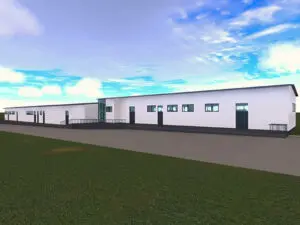
 Company Center Ltd. has been working in the field of design for 10 years.
For you we provide:
- analysis of the site for construction, formation of a report on the condition of the site and connection to engineering networks, engineering surveys (geodetic, geological, hydrogeological);
- adaptation of technologies and foreign projects in accordance with the state construction norms of Ukraine;
- town-planning calculation;
- sketch project of building intentions;
- preliminary definition of the main technical and economic indicators of construction (feasibility study)
- design of industrial facilities and structures of stages P, R, RP;
- analysis of existing projects, optimization of decisions;
- analysis of project implementation costs;
- preparation and maintenance of a package of documents for obtaining permits;
- engineering and construction consulting;
- author’s supervision over the state of construction and reconstruction.
We have extensive experience in designing industrial facilities in such areas as: engineering, logistics, food processing and agricultural profile (meat plants and meat processing plants; cheese factories; fish shops; canning shops; warehouses; refrigerators and compressor shops; storage, processing of fruits and vegetables, feed mills, oil production shops, livestock farms), ancillary facilities to service the production of hot water and steam boilers, transformer substations, automatic pumping stations for firefighting, disbarriers, air compressors, and other engineering structures.
The task of “Company Center Ltd.” is to develop a project to ensure:
- achieving the goals of the owner
- safety of workers at work
- sustainable development for the environment
- maximum productivity of a new industrial facility.
Our specialists develop design and estimate documentation at the following stages:
- feasibility study, calculation;
- sketch project;
- project;
- working project;
- working documentation.
Feasibility study, calculation (feasibility study, TEC – Techno-Economic Calculation)
Feasibility study is necessary for production facilities that require detailed justification of relevant decisions and determination of options and feasibility of construction or modernization of the facility. TEC is used for technically simple production facilities.
Feasibility study (TEC) summarizes production capacity, product range and quality, production cooperation, supply of raw materials, electricity and heat, water and labor resources, taking into account the choice of a specific site for construction, estimated construction cost and main technical and economic indicators. Feasibility study after approval (acceptance) for three-stage design or approval of TEC in two-stage design in the manner prescribed is the basis for the development of the next stage of design.
Sketch project
The preliminary design is developed for the basic definition of requirements to town-planning, architectural, technological and functional decisions of object.
The preliminary design reflects the location of the object on the site, architectural solutions, technological solutions, preliminary calculations of all engineering networks and environmental impact assessment. The sketch project for substantiation of the accepted decisions on the task of the Customer includes schemes of engineering maintenance of object, calculations of estimated cost and substantiation of efficiency of investments, town-planning substantiation of location of object.
Project
Stage Project (P) is developed to determine the urban, architectural, artistic, environmental, technical, technological, engineering solutions of the object, the estimated cost of construction and technical and economic indicators.
Sections P should be submitted in a clear and concise form without excessive detail in the composition and volume sufficient to justify the design decisions, determine the scope of major construction work, the need for equipment, building structures, material, fuel and energy, labor and other resources, provisions on the organization of construction, as well as determining the estimated cost of construction.
Material and technical resources of individual structural elements can be determined by appropriate analogues without performing structural calculations. The project (P) is subject to approval, which is the basis for the development of the next stage of design.
In stage (P) the following sections are developed:
- General explanatory note;
- Master plan and transport;
- Technological solutions;
- Architectural and construction solutions;
- Heating and ventilation;
- Water supply and sewerage;
- Heat supply;
- Gas supply;
- Air supply;
- Cold supply;
- Inter-shop technological communications;
- Power supply and electric lighting;
- Automation and instrumentation;
- Communication systems;
- Automatic fire extinguishing and fire alarm systems, other fire-fighting measures;
- Environmental impact assessment (EIA)
- Construction organization project;
- Estimate documentation.
Stage Working documentation, working project (WP)
Stage “Working Documentation” (WD) is developed on the basis of and based on the decisions of the previously approved stage “Project” (P) for construction and installation work.
The volume and detail of working drawings should be brought to the minimum necessary volumes
The initial data for the imported equipment and drawings for the equipment of individual production are given out to the designer by the Customer before the beginning of development of working documentation.
The WD for construction should include:
- Master plan and transport;
- Technological solutions;
- Architectural and construction solutions;
- Heating and ventilation;
- Water supply and sewerage;
- Heat supply;
- Gas supply;
- Air supply;
- Cold supply;
- Inter-shop technological communications;
- Power supply and electric lighting;
- Automation;
- Communication systems;
- Automatic fire extinguishing and fire alarm systems, other fire-fighting measures;
- Passport of finishing works;
- Estimate documentation;
- Specification of equipment, products and materials;
- Questionnaires and dimensional drawings for relevant types of equipment and products.
We develop all sections of the project and support the examination of project documentation in the bodies of state supervision and control.
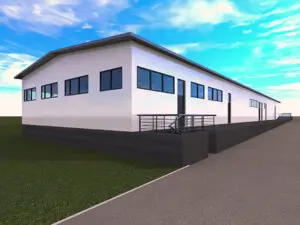 During the execution of the project documentation, the specialists of Company Center Ltd. pay attention to the following important issues:
- The optimal design of the building.
The first thing to think about when building an industrial facility is how to design the space to ensure optimal power and efficiency. The location of office space, equipment, storage, shipment, receipt of raw materials will have a significant impact on the work process. That is why the design of your building is of paramount importance. To create the perfect layout, we clearly work out for you the sequence of operations that take place on site, taking into account the manufacture, delivery and receipt. The project architect develops an effective layout that avoids production inefficiencies.
- Easy entry and exit for your convenience.
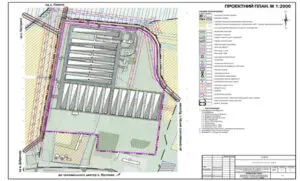 Having a well-thought-out site plan for easy entry and exit of trucks (delivery of materials) is a key factor for uninterrupted production, warehousing or distribution. Your delivery and receiving area is one of the most valuable properties in your building, as most of it passes through this space. If you want to load the exit vehicles while receiving the incoming loads, you will need space in the area of the ramp approach to maneuver several large vehicles. In other words, designing a two-way traffic flow is an important step in the design process.
- Determining the optimal height of the building.
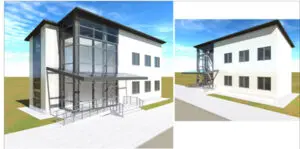 Massive equipment is often placed at production facilities and overhead conveyors are used for production operations. Warehouses and distribution centers typically include high pallet racks and require space for forklifts and other domestic vehicles. If your building has too low a ceiling, you will need a larger building for storage and equipment, instead of using a clear stack height. Therefore, adequate ceiling height and width to accommodate all types of equipment and movement is another important factor in industrial construction.
- Reinforcement for heavy loads.
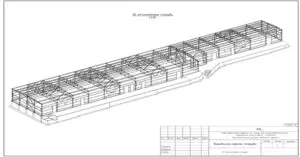 Industrial and warehouse buildings inevitably face heavy loads as well as harsh chemicals. The most important aspect of construction is the installation of support panels and the choice of floor coverings that can withstand the load. Due to the extreme pressure that equipment and industrial vehicles can put on the foundation and floors, for industrial structures usually require concrete foundation slabs. Depending on the use of the building, a foundation consisting of concrete supports or beams that carry the weight of heavy equipment may be required. In addition, the type of interior flooring is important. Production facilities require solid precast concrete that can withstand the pressure and stress of heavy weight and movement. The finish should be thick, strong and chemically stable.
- Proper ventilation.
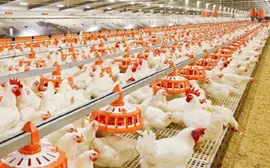 A well-designed ventilation system will move the air at the appropriate speed, removing unnecessary contamination. This reduces the number of accidents at work. Properly designed industrial ventilation systems reduce the risk of environmental pollution, prevent fires and protect workers from heat stroke.
- Sufficient lighting.
Lighting is a simple aspect that can be missed when designing an industrial space, because a large area of the production room or warehouse requires a lot of light. Our designers will choose the best option for you, where you can make the most efficient use of natural light.
Company Center Ltd. provides professional design of industrial facilities. We understand the unique features and long-term prospects of your business – from project development to the safety of your employees and the environment.
Our experience and responsible approach to design ensures your success in the planned activities.
With us you save time and money, getting a quality and expected result!