Requirements for modern solid waste landfills: from design to construction

Amendments to the Law”On Environmental Impact Assessment” will accelerate Ukraine’s post-war recovery
28.07.2023
Calculation of greenhouse gas (CO 2 ) emissions for Ukrainian exporters using the CBAM mechanism
04.08.2023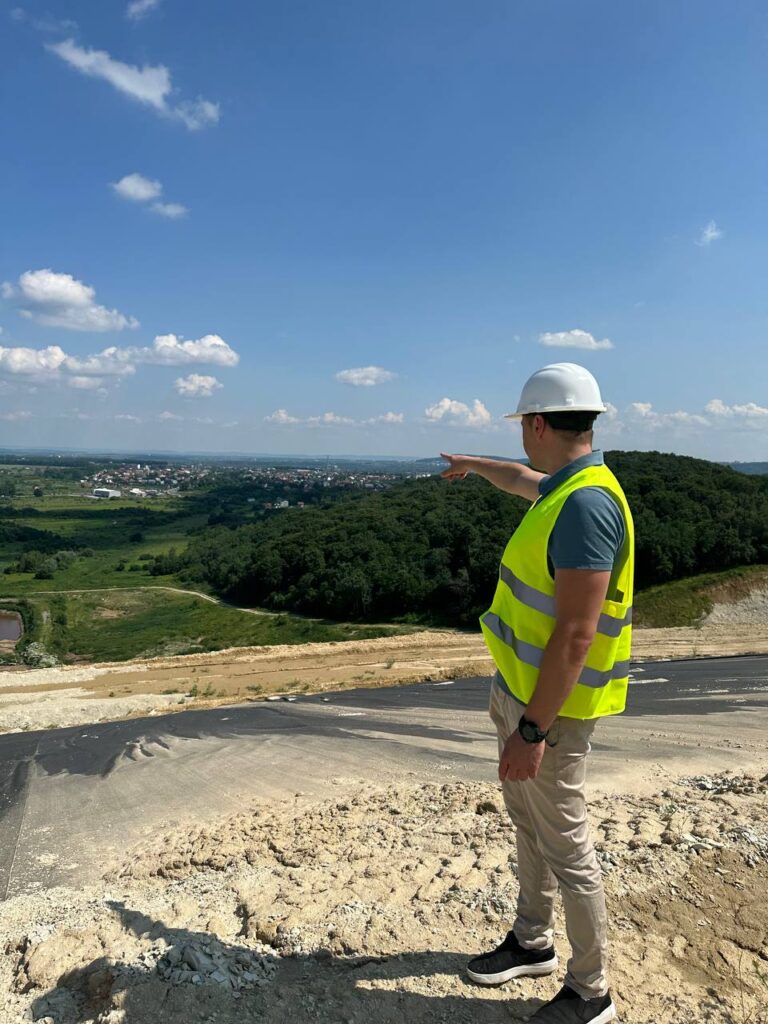
Waste management is one of the most urgent environmental and economic problems of Ukraine.
Today, there are 20 operating landfills with a total area of 152 hectares in the Lviv region alone. The
vast majority of them work in an overload mode, that is, with a violation of the design indicators
regarding the volume of waste accumulation. Landfills are a source of intense pollution of soil,
atmosphere and groundwater.
Disposal of waste should be carried out in municipal solid waste landfills (SW) that meet the
requirements of the legislation and the technological equipment of which ensures the protection of
groundwater, extraction and neutralization of biogas and leachate, monitoring of air emissions, soil
and groundwater pollution.
One of the main indicators that affects the level of improvement of territories is the presence of solid
waste landfills. Therefore, address waste management through the construction of modern safe
landfills is an extremely urgent issue for communities.
Modern landfills are engineering structures that meet the state and international standards and are
designed for household waste collection and disposal.

Successful design of a modern landfill site requires an integrated approach, consideration of
environmental and sustainable practices, as well as interaction with all interested parties.
Among the key requirements to be considered during the design and construction of landfills are the
following:
1. Consideration of norms and standards: the initial step is a detailed study of national and
international norms and standards for waste management and environmental safety.
Integration of these requirements and risks into all design and construction phases is
essential to ensure compliance with environmental and safety standards.
2. Selection of the appropriate territory: landfills should be located at a distance from populated
areas and water sources. The site for the placement of landfills should be selected according
to the territorial principle in accordance with the sanitation scheme of the city or region and
the district planning project or the general plan of the locality.
3. Technical planning: the planning should consider optimal landfill configuration, waste
collection, treatment and disposal area, as well as ensure the tightness of the landfills
(installation of membranes, geotextiles or other engineering barriers that do not allow liquids
and gases to pass) and an efficient wastewater collection and treatment system.
4. Monitoring and control: waste disposal is carried out in accordance with ecological, sanitary
and epidemiological requirements, which minimizes possible impact on human health and
the environment. Landfills should be equipped with monitoring systems that allow
monitoring the quality of soils, underground and surface water, and atmospheric air, as well
as the effectiveness of measures implemented.
5. Public Involvement: Successful landfill design involves public and stakeholders participation
in discussions, taking into account their views, dealing with opposition and promoting
support for the project.
6. Closure and remediation plan: Landfills must provide for closure and remediation plans to
ensure that the environmental conditions of the facility are restored after closure.
7. Occupational Safety: Consideration of occupational safety for landfill personnel is critical,
including the development of security measures and training of personnel.
8. Ensuring long-term sustainability: landfills should be designed for long-term sustainability
and sustainability of environmental impact, in particular taking into account the possible
effects of climate change.
Designing landfills is a responsible matter, because such objects pose an increased risk to humans
and the environment. Three stages of landfill design can be identified: analysis of the existing
situation, design, project expertise, which include:
1. Analysis of the current situation: first of all, during design all existing environmental aspects
and risks should be taken into account as well conditions and limitations of urban planning,
legislative requirements, in particular, the requirements of SBN V.2.4-2-2005 ” Municipal
solid waste landfill “, “Rules for the operation of landfills household waste”.
2. Design: the draft landfill includes the following main sections – explanatory note; the
decision of the general plan; technological solutions; internal engineering networks, which
include systems of drainage, collection and disposal of leachate; calculation of the expected
amount of biogas; environmental impact assessment; graphic materials; construction
organization; architectural and construction solutions; estimates, etc.
3. Expertise of the project: carried out by expert organizations that are included in the list of
expert organizations and meet the criteria established by the order of the Ministry of Regions
dated August 15, 2017 No. 204.
A modern landfill for a community depends on various factors, such as community size, volume
of waste, budget, available resources and local conditions.
The main task when choosing the type of landfill is to ensure efficient and ecologically safe
waste management, which takes into account the interests of the community.
The main task when choosing a company that will ensure the development of a high-quality project
of a modern landfill is a professional approach, experience in the implementation of similar projects
and the use of innovative technologies in solving complex tasks.
The experience of the “Center LTD”Company, a responsible approach to design, application of
innovative solutions, optimization of cost, implementation of a full cycle of services, consideration
of the interests of the community and priority in the protection of the environment and people’s
health ensure your success in the planned activity. The company cooperates with many European
partners and has in its portfolio dozens of developed projects for large and small cities of Ukraine.
For professional advice, call: +38 096 781 05 37, +38 067 725 54 32, or send questions to:
[email protected]